Friday, June 12, 2020

World Pandemic: Claude Bosana

Claude Bosana, World Pandemic, 2020
Claude Bosana (Kinshasa, DRC)
World Pandemic
2020

Reflections by Elaine Sullivan, Mark Auslander, Laurie Kain Hart

Overview: A painting of the Kinshasa School. The SARS-CoV-2 virus is represented as a giant, invading monster, out of horror film, its protein spikes protruding with menace. Explosive force seems to emanate from the virus, with a darkened field on the left. A uniformed medical worker tries to hold the creature at bay, as a kneeling woman prays for mercy beneath it, an open bible and various national flags and medicines scattered before her. To the left, we see a running skeleton and other human bones, to the right. young men flee down the road. Behind them green-uniformed medical workers their arms rasised in supplication.  Various world leaders, most prominently Queen Elizabeth II and the Pope.  are seen in masks. On the upper horizon line, we see identifying world landmarks, from Big Ben and St. Peters to the Statue of Liberty and the Great Pyramids. Small red viruses float through the air.

Elaine Sullivan (UCLA World Arts): This painting feels like a snapshot of the first month of the pandemic. The virus had already spread widely in parts of Asia, Europe, and the US, as represented by the monument sin the top right. Masks became the symbol of our individual responsibility to the collective (though this painting is the first time I’ve seen one on Donald Trump). Many made do with what they had, such as bandanas or in the case of our health-worker hero, foliage. Chloroquine stands next to a bible, its placement a reminder of the near-religious fervor with which it was discussed in the early months of the pandemic. A ghostly group of medical professionals appeal to impassive poltiical leaders of China, the U.S. and France. Scattered across the lower half of the painting, Bosana has included the DRC’s corona-vocabulary: “confinement,” “quarantine” “depistage” (screening) “OMS” (WHO). Online, some parts of social media seemed to be eagerly awaiting the uncontrolable spread of the virus on the African continent, and in the painting the virus building up against our hero, ready to topple him at any moment. The virus’ energy moves from top left to bottom right, but luckily our leaf-masked hero holds it back. On the bottom right, where the virus seems headed, young men run away, out of the path of destruction.

Mark Auslander:  The kneeling medical worker constitutes the key vertical dividing line in the painting, between scenes of danger to the left and imperiled humanity to the right. In the bottom left we see a skeleton, avatar of Death, running away in the darkness; in the upper, lighted right, we see the beloved figures of Queen Elizabeth II and the Pope. This binary distinction is consistent with a tendency noted by Georges Dupré (1992) in the work of Tshibumba Kanda-Matulu  (1947-1981) and other Congolese (then Zairois) painters to organize their canvases in a Manichean fashion, with death, evil. and darkness to the left, and  life, good. and light to the right. (Many thanks to Allen Roberts for alerting me to Dupré's insightful essay). Dupré suggests that this mode of thought, that left is to evil as right is to good,  is deeply anchored in traditional Congolese cosmology. As noted by Robert Hertz (1907)  in his classic essay, "Death and the Right  Hand," numerous cultures around the world draw this distinction, and tend to assign rightness to the male, and leftness to the female: consistent with this scheme, the heroic male medical figure is to the right of, and above, the kneeling, praying female figure.  The deadly protein spikes of the virus on the left are contrasted on the upper right with the spires of human civilization, including the Eiffel Tower, the Tokyo tower, and the Statue of Liberty (her torch appropriately held high in her right hand.)

Hertz, it should be noted, also observes these dense binary contrasts have a paradoxical consequence in ritual and cosmology the world over: a profusion of negative valuations on the left (sinistre) side has the productive effect of constituting and calling into existence goodness itself. There is no light without the dark. Such is clearly the case in the Bosana painting, in which the phantasmagoric plague to the left actively catalyzes a sense of united humanity on the right side.

The large virus that towers over the hero  (whose gloved hands try to keep the creature at bay) is rather like a massive military mine, its exploding force scattering international flags, its protruding protein spikes a bit reminiscent of old blunderbuss firearms or artillery cannon, expelling tiny red viruses like fall from above like the bombs of the Blitz. The skeleton, skull,  and bones in the lower left may evoke the Danse Macabre of early modern European paintings, reminders in a time of pestilence that all earthly things may imminently pass away.

Bosana's exuberant image can be thought of as a kind of homage to garish "B" grade horror film posters, as an otherworldly, grotesque creature threatens of all of humanity, a lone hero standing firm as the rest of the world watches in horror. These poster themselves  borrowed liberally from earlier paintings of St. George slaying the Dragon and saving the maiden. We may even in Bosan's corpulent virus see of a hint of Star Wars bloated' Jabba the Hutt, slain by Luke Skywalker as he rescues Princess Leia.

Speaking of movies, Bosan's picture, while born of our moment of anxiety, is equally a celebration of how the global community is now bound together through the images we view every day on screen. To my eyes, the large virus and the glowing round blue field surrounding it are reminiscent of the shape of an old television receiver.  The delightfully malevolent virus in effect bursts through the TV screen, right into our living room and city streets.  Like an old horror flick, the scene is both terrifying and enormously entertaining, as we are all around the world bound together in the shared pleasures of being spectators to the Apocalypse, brought to us live in living color.

Laurie Kain Hart (UCLA):  It is striking that the most prominent world leader pictured here is in fact Queen Elizabeth II, who is awarded honorary right hand "male" status.  The other large scale figure is the Pope, which suggests imperial and ecumenical associations that are consistent with a resurgent "globalism" as opposed to nationalism per se, at this moment of world crisis. To be sure, the Queen and the Pope, especially when viewed historically  have ambivalent moral stature: they could be considered icons of the worst abuses of Empire, and yet at the same time they signal an infrastructure of global interconnection. In contrast, the male national political political leaders (from China, the US and France) shown here are relatively puny: the real emphasis is on leaders whose standing (and ambiguous historical reach) extends beyond the nation per se.

References

Dupre, Georges 1992. "La signification de la perspective dans sept tableaux de
Tshimbumba Kanda-Matulu" in Art pictural zaïrois. Sous la direction de
Bogumil Jewsiewicki
. Lille : Presses du Septentrion,

Hertz, Robert, 1960 (1907). Death and the Right Hand (trans. Rodney and Claudia Needham.) London; Cohen and West

Tuesday, June 9, 2020

Lockdown (dance): Khaya Ndlovu

Khaya Ndlovu
“Lockdown,’ 
26 May, video, 3:49
University of Johannesburg Arts & Culture

The Pandemic: An Interdisciplinary Art Project

Web page:  https://arts.uj.ac.za/show/PANDEMICKHAYA/
Video: https://youtu.be/ne6eQZ2rI10

Overview  Video of dance performance, with the artist initially behind an iron gate, then at one point running outside and on a park bench,  before returning indoors.


Artist's Statement: Being in a confined space when you are used to being out and free, you eventually start living in your thoughts. This made me write a poem which is illustrated my feelings while creating this work. What I created was a visual journal rather than a dancer dancing to music but, rather leaving thoughts that are connected through movement. 

Personally, I was affected positively and negatively because I always wanted to go digital But finding a to retain that face to face impact that artist need within their workspace has been hard to balance. Yes, financially it hits deeper. If you are not connected with WIFI then it will take a toll on your pocket. 

It saddens me to see that theatre spaces have been affected badly by COVID-19. However, this is the perfect time for the arts to evolve.


Pamela Allara: At the start of the coronavirus pandemic in March of 2020, the University of Johannesburg immediately called a halt to all of its arts programming, as did universities and arts organizations throughout the country as a whole. In response to the loss of those things of which “the pandemic has robbed us”, Pieter Jacobs, head of the UJ’s Arts & Culture program, announced the establishment of The Pandemic project, which would build on the existing collaborative and interdisciplinary initiatives at the University. On May 11, the UJ Choir released its 9th album, “When The Earth Stands Still,” and on the same day The Pandemic project asked 19 visual artists and 9 dancer/choreographers to submit a short (3-4 minute) time-lapse video that would respond both to the music and to the closing down of exhibitions and performances due to the crisis. To date, 7 videos documenting the artists’ initial responses have been uploaded to the website, and in 2021, the resulting videos, as well as the completed artworks, will be exhibited at the University Art Gallery.
 https://arts.uj.ac.za

Fana Tshabalala’s dance performance, “Confined By Numbers,” was released on May 22, and as Mark Auslander observed in a previous post, it succeeded in making a virtue of the fact that this most physical of the arts had to be presented in virtual form. The same is true of dancer/choreographer Khaya Ndlovu’s “Lockdown,” which was released on May 26. Although a haunting song from 1982, Ngonthando (In love alone), plays in the soundtrack, Ndlovu insists in her statement that the work is a visual journal, not a dancer dancing to music. Indeed, this work is a prose poem that she recites while moving from a barred, prison-like door, to walking along a tall, black fence, to running outdoors in an empty street. As she moves from inside to outside and back again, her attire changes from a geometrically patterned jump suit to a flowered dress, further marking the contrast between freedom and confinement. Her poetry and her dance movements are closely aligned: for instance, as she walks barefoot on dry, dead leaves blown against the seemingly endless fence posts, she asks: ”So this is what they meant when they state jail strips everything out of you?” After a beautiful interlude of dancing with her back to us in an empty street and wondering aloud about the next generation of artists, Ndlovu sits on a park bench and remarks sadly, “Jozi my city you are missed.” Returning to the prison cell-like door that appears to be the entrance to her home, she raises her arms through the bars in a prayerful gesture, and declares, “If my body can’t move, I’ll allow my soul to move.” The video thus ends with the affirmation of what the creative arts can do in a time of crisis, and that is to provide solace and inspiration.


Mark Auslander;   For generations, political legitimacy in South African liberation circles was bound up in narratives of imprisonment and liberation.  In poetry, literature, film and art, periods of incarceration were honored as trajectories of moral and spiritual rebirth.  In the 1988 film Mapantsula, for example, a small time hoodlum played by Thomas Mogatlane who had long served as an informant for Apartheid security services rediscovers within the prison cell a sense of moral integrity that he had thought long lost, and reclaims his voice as a powerful resistor to oppression.  In  the darkest moment of the State of Emergency, the prison is figured as the entire polity in microcosm on the eve of radical transformation. 

This narrative of rebirth through imprisonment is most famously developed in Nelson Mandela's Long Walk to Freedom, in which the national dream of a multiracial democracy is forged: "It was during those long and lonely years that my hunger for the freedom of my own people became a hunger for the freedom of all people, white and black. I knew as well as I knew anything that the oppressor must be liberated just as surely as the oppressed." Precisely at the moment of maximum physical restriction,  the mind, and the soul, can run free to remake the nation in a new inclusive image.

This deep seated history provides the context of Ndlovu's film. Confinement within the household during Lockdown, while nowhere near as oppressive as actual incarceration,  is figured as a liminal period of contemplation, self-discovery, self-fashioning, and rejuvenation. The sense of confinement continues as the artist heads triumphantly out on the street, her arms upraised, while contemplating her  empty city, her fellow citizens confined. As the artist returns beyond the bars of her normally locked house gate, she moves in and out of the gate, exploring her veritable cell with her arms and the soles of her feet. At the end  she stands  triumphantly, fading into a image of her bent over in contemplation on the bench, towards her closing epiphany:  "If I cannot run with my body, then I'll allow my soul to run."  As in generations past, the compressed space of confinement paradoxically catalyzes personal liberation and a a new birth of freedom for the entire nation, on the brink of becoming something that still cannot quite yet be imagined.

Saint Corona: Christiaan Diedericks


Christiaan Diedericks
Saint Corona (Dark - a single diagnosis of health)
Monotype on 300gsm Hahnemühle etching paper
TLC Extension Collection (2020, South Africa)

Overview: A bearded African man in three quarters profile is depicted in the manner of a Renaissance representation of a Saint, his eyes lifted heavenwards, with a halo or crown in the shape of the novel coronavirus, SARS-CoV-2. A background wash is primarily composed of orange, reds, and browns echoing the hues of the crown itself with a vertical swath of blue to the right.


Artist's Statement:
Saint Corona actually existed and is especially venerated in Austria and Bavaria as the Patron Saint against plagues and epidemics. In Anzù, Northern Italy, the hotbed of the Coronavirus in Europe, is a basilica where the relics of Saint Victor and Saint Corona are being preserved since the 9th century. Saint Corona was only fifteen when she professed her Christian Faith during the persecution of the Roman emperor Marcus Aurelius around 165 AD.

Currently the whole world is in the middle of the novel Coronavirus (Covid-19) pandemic with many scientists struggling to develop a vaccine against it. The virus outbreak has also disrupted the daily life of millions of people all over the world and most countries are under strict lockdowns globally.

Saint Corona in my work is depicted as a black man with a crown or halo resembling the novel Coronavirus or Covid-19. The depiction of the saint as a black man specifically refers to geography or place, to Africa and more specifically South Africa where we are still anticipating a major spike in infections. However, the reference to a specific race is a deliberate strategy employed to highlight the vast class divide existing in South Africa. While most privileged white people are able to wait out the imposed lockdown in the comfort of their homes, millions of black people are literally starving to death. This “plaque or epidemic” exposed the terrible reality of scores of hungry black people anticipating food parcels in queues of up to two kilometres in South Africa right now.

A second narrative exists in my Saint Corona and investigates the parallels between the dreaded HIV virus in the eighties and the Coronavirus pandemic today. For me personally, a grim irony presents itself in the fact that the whole world is now in a complete state of panic and researchers are frantically searching for a vaccine (not that I am inferring that we should not take the outbreak very seriously). During the early 1980's during the outbreak of the HIV virus, the entire world turned a blind eye and labelled the pandemic "the gay plague".   Money for research was only made available many years later after an unfathomable amount of gay men died and only when heterosexual people started dying as well. Nearly four decades later the HIV virus killed vast amounts of people and is still affecting millions living with HIV/AIDS globally. There is still no vaccine or cure. To add fuel to this fire many HIV positive people are stigmatised.

Mark Auslander:  The artist's double title for this work "Saint Corona (Dark - a single diagnosis of health)" alludes to a paradoxical feature of the global pandemic, with reference to race and class: although  a single virus type, SARS-CoV-2 threatens all of humanity, the dangers of Covid-19 are disproportionately experienced by communities of color in Africa and the Americas, due to co-morbidities shaped by a range of factors, including preexisting medical conditions, emerging out of poverty and unequal access to health care. As painfully depicted in TLC artists Themba Khumala's Waiting for Food Parcels and Kim Berman's State of Disaster, the economic, housing, and food security impacts of the Lockdown have been exponentially magnified in poor black communities. There may be a single biomedical diagnosis for this disease condition, but from a social medicine perspective, we need multiple diagnoses of the forms of structural violence that plague low income communities of color in South Africa and many societies around the world.  The protein spikes of the novel coronavirus that  Christiaan Diedericks has placed around the head of the Saint can also, in this light,  be read as a latter-day crown of thorns, the piercing ravages of social inequality and oppressive policies that unspeakably extend the devastating impact of the virus for many people of color.

As the artist notes, this history of unequal risk posed by a virus has a particularly painful proximate history in South Africa. Low-income communities were particularly impacted by HIV/AIDS, in large measure due to the Mbeki administration's long reluctance to make anti retroviral therapies affordable and available to poor patients, and crises of public health delivery compounded by rural and urban poverty, anchored in the long history of Apartheid social engineering. During the peak of the HIV/AIDS crisis, some South African aritists envisioned persons with AIDS in the figure of a Black Christ, martyred by ill-conceived policy and legacies of structural racism: Diedericks' new image continues this iconographic tradition.  As in earlier eras, in the face of the Saint we see reflected our own collective shortcomings as well as our aspirations for a better world.

Saint Corona in the Era of #GeorgeFloyd

The artist has shared that this monotype was inspired by Jericho Brown's remarkable poem, The Virus,
which prophetically conflates a biological pathogen with the virus of racial hatred, an insatiable impulse to kill and eradicate all those of darker hues. At our remarkable current moment, Diedericks' print seens equally prophetic. 

Seen through American eyes in June 2020, this portrait of a lightly bearded martyred black man takes on new, urgent associations that were largely unanticipated when the artist created the work many weeks ago. As the US and the world experience mass protests denouncing the murder of George Floyd and many other black and brown people at the hands of the police,  "Saint Corona" inevitably comes to stand for, and perhaps to intercede for,  these lost souls as well.  The same complex history of systemic racism that has conditioned the disproportionate impact of Covid-19 on black communities has also occasioned pervasive police violence against black bodies, emerging directly out of the plantation slavery system and post-Civil War efforts to re-imposed "slavery by a different name," through the mass criminalization of black life.

Mural of George Floyd, at the site of his murder in Minneapolis, MN
The origins of the present crisis of police violence against low income people of color in South Africa have different, if related, origin stories, anchored in elite struggles to contain labor and political unrest in urban centers; in violent fantasies of black peril that were, tragically, internalized in many low income communities; and in the restructuring of cities as urban "battle spaces" under Apartheid.  Post-1994 liberal reform in the political sphere in South Africa did not provide, for millions of people, economic justice or an equitable experience of law enforcement, and the resulting loss of police legitimacy has left many urban and periurban communities in a continuing state of low level civil war. (Comaroff & Comaroff 2009, 2016).

The militarization of policing in the US and in South Africa is an enormously complex phenomenon, but at heart it reflects a long-running ideological refusal, in Ta-Nehisi Coates (2015) vigorous phrase, to allow black people, "the right to own their own bodies."  May the noble visage of Saint Corona, long a guardian against pestilence, now serve as a defense against the modern plague of racial violence in its many forms, and remind us all of the dignity and self-sovereignty of bodies and persons of color during this time of deep peril.

References

Ta-Nehisi Coates. 2015.  Between the World and Me. Spiegel & Grau

Jean Comaroff and John Comaroff.  2009. Of Revelation and Revolution: The Dialectics of Modernity on a South African Frontier. Chicago: Chicago: The University of Chicago Press. 

Jean Comaroff and John Comaroff.  2016. The Truth about Crime: Sovereignty, Knowledge, Social Order. Chicago: The University of Chicago Press. 


For more information:
#TLCExtensionCollection #ArtForGood #TheLockdownCollection


Monday, June 8, 2020

Masked Figures: Ben Yumba

Ben Yumba
Ben Yumba
(Lubumbashi, Democratic Republic of the Congo)
Two paintings, May 2020

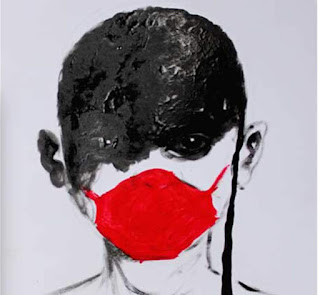
Overview:Two paintings present heads wearing masks. Both heads are heavily textured, in ways that may recall the surface of a planetary body. One head looks up in profile with a mask depicted through yellow lines; the other head faces us, wearing a red masks.

Framing Remarks.  Jean Katambayi, president of PICHA, the artist's association in Lubumbashi, has offered some reflections on the current global situation, under the tile,   Les lignes confinées ( "Confined Lines") with the framing remark that "the world still breathes." (Translation from French below).


Ben Yumba (Source: PICHA Newsletter)
Des mots et expressions méconnus, connus ou mal connus, définissent la vie incertaine que l'humanité traverse. Loin de savoir si des cartes se jouent dans les coulisses, la vitesse de communication symbolisée porte à interroger la perception et la diffusion des épidémies des siècles passés. Le confinement traduit par lockdown en anglais reste le maitre-mot. Il est suivi du déconfinement.

Mais au moins l'humanité a compris qu’il est possible de se passer de certaines inventions tant matérielles qu’immatérielles. La peur de l’inconnu fait remonter à la surface toutes sortes de spéculations — comme pour paraphraser les approches complémentaires des futuristes qui affirment à la fois que le connu est passé et que le connu reste à venir.

En dépit de tout, le présent qui se situe entre ces deux temps, réclame concrètement que l'être vivant humanoïde perde un peu ses repaires. D'autres termes du moment sont : vaccins, emploi, économie, distanciation sociale, masques, visière, récession, geste-barrières, Afrique, Chine, Europe et riposte. Heureusement que les artistes et les hommes d'églises ne tarissent pas d'inspiration pour tenter de survivre dans ce confinement qui aura peut-être vacciné des modifications de comportements au Nord et au Sud.


Translation:  The uncertain life that humanity is now  going through is defined by little known words and expressions, perhaps unknown or misunderstood  Far from knowing whether cards are played behind the scenes, the symbolized speed of communication raises questions about the perception and dissemination of the epidemics of past centuries. The Confinement, translated by “Lockdown” in English,  remains the key word. It is followed by De-confinement.

But at least humanity has understood that it is possible to do without certain inventions, both tangible and intangible. Fear of the unknown brings to the surface all kinds of speculation - as if to paraphrase the complementary approaches of futurists who claim that both the known is past and the known is yet to come.

In spite of everything, the present which is situated between these two times, concretely demands that human beings lose our our dwelling places to some extent.  Other terms of the moment are: vaccines, employment, economy, social distancing, masks, visor, recession, barrier gestures, Africa, China, Europe and response. Fortunately, artists and clegy are full of inspiration , helping us survive in this confinement which may vaccinate  behavioral changes in the North and in the South.


Pamela Allara;  Benjamin Yumba received his BFA from the Academy of Fine Arts in Kinshasa, and since 2007 has been working in painting, photography and video. In 2019, he was the Exhibition Production Coordinator for the 2019 Lubumbashi Biennale. His two paintings from May of this year are both poignant portraits, one male one female. Isolated against a plain ground, the portraits speak to confinement. The country has been under lockdown, but many in the informal sector still venture out to sell their wares in the streets, often without masks. The young woman looks upward as if appealing for help from the spreading pandemic, perhaps from authorities. The young man faces us, his red mask askew. The artist employs the strongest of value contrasts: red, black and white, which forces us to confront the fact that the boy’s race is not just mixed, but divided between the upper and lower half of his face. This effect may simply be due to face paint, but it extends to his neck and upper shoulders as well. In the Congo, the coronavirus has been dubbed the disease of the rich, the elite. And so, perhaps Yumba is referencing the fact that the whites can be protected while the blacks are exposed. This is pure speculation, but the portrait’s strong contrast compels this writer to propose an explanation of some sort!


Mark Auslander:  The textured heads of these two figures by Ben Yumba, especially the one wearing a yellow mask, put me in mind of a small planetary body, its surface marked by craters from impacts across the ages.  It is hard not to think of the Little Prince in Antoine de Saint-Exupéry's beloved book,  Le Petit Prince, residing on a tiny planetoid, forever on guard for baobab trees that might swallow up his entire world.   During the Lockdown, humanity is undergoing enforced social distancing, yet we find ourselves strangely bound together, as we all undergo a shared crisis, although we inevitably understand that crisis through very different lenses.  The emerging global #Floyd movement against police violence and for a new covenant of racial justice is a particularly powerful illustration of all that now binds us together, on our shared small planet. 

The artist's theme of "confined lines" (Les lignes confinées) references, first and foremst, the words and phrases of written text, the new language which, in our newly compressed existence, we are groping towards developing.  In  Yumba's paintings, the confined lines are also the narrow ties that bind our life-saving masks, our new uniform of shared human compassion and protection.  around our heads or behind our ears.   The yellow mask on the upraised head, gazing towards the heavens in search of deliverance, is, appropriately, painted only as lines, with empty space between them.  These lines are confined, but they do not block individuals, or humanity, from breathing. We can still take a breath,  take a pause, and recalibrate ourselves, with the hope of breathing together in shared love and compassion for all of us, the Dead and the Living. 

The Little Prince, it is worth remembering, has come to earth in search of a sheep. to protect his fragile planet, without threatening his beloved single rose.  The narrator's solution turns out to be create a  drawing of an invisible sheep confined in a box that will keep it safe and prevent it from consuming the unique rose after the sheep  has grazed for baobabs.

The earthly body of the Prince must pass away for him to return to his distant tiny planet and his singular flower, but we sense that the essence of the drawing has endured, through the lasting bond of a creative gift.  Is that not a lesson for our time? As we lose so many souls, in this time of global confinement, as we live our lives anxiously  between and behind the lines, the power of art, and the confined lines created by artists, are more life-sustaining than ever.


Sunday, June 7, 2020

Confined by Numbers: Fana Tshabalala.

Still from "Confined by Numbers" Fana Tshabalala
Fana Tshabalala.
"Confined by Numbers" (Dance work, filmed: 3 minutes, 32 seconds)
Featured in The Pandemic Project
(University of Johannesburg Arts and Culture)


Overview: Dance piece performed in the confined space of a laundry room, during Lockdown.  The performer is dressed in white.

All the artists in The Pandemic Project, based at the University of Johannesburg's School of Arts and Culture, have chosen a musical piece recorded by the university choir.  The artist for this work has chosen the song Sejedo (in the West African language of Fon) by Angélique Kidjo,  arranged by Sabelo Mthemb.  performed by the University of Johannesburg Choir.


*Video is at:  https://youtu.be/-xvZ9CMSlLk
Full page is at:   https://arts.uj.ac.za/article/the-pandemic-project-fana-tshabalala/


Artist's Statement:  The work is inspired by the UJ Choir’s rendition of Sedjedo by Angélique Kidjo arranged by Sabelo Mthembu and featured on When the Earth Stands Still.  My piece ‘Confined by Numbers’ is the exploration of the unstable mental state. The constant changes in its surrounding affect its ability to be independent. The only way to survive, is to re-imagine and re-create the context of every moment and experience.
 
Mark Auslander:  While we are dazzled by the dancer's virtuosic artistry, we also find  ourselves immediately recognizing the predicament before us. Untold millions around the world during the various forms of pandemic-induced lockdown have surely found ourselves wandering around the confines of a small space in our homes,  our minds filled by all manner of thought, from terror of contagion to the most basic question of what domestic task to turn to next.  Our dwelling spaces have become the theatrical stage for so much of our inner psychic lives of late.
 
Here, we are invited into the tumult of the protagonist's mind. The opening shots are low, showing the dancer twisting on the floor, his right arm then raised up as if aspiring to something higher. He stands up, still rotating, as his arms continue to explore the taut space around his upper body.  At one point he glances at the fingers of his hand, evidently referencing the work's title, "Confined by numbers." How many hours and days have we been locked down? How many more until we can safely re-emerge? How many are infected, dying, transmitting, recovering?  How many are out of work?  At one point he leaps upon the counter as if to rest in thought, but then immediately is standing again, momentarily grasping his temples,  his fingers then counting more numbers, more casualties.  Numbers are projected quickly across the screen.

His knees fall back to the floor, his arms resting on the sink, as his lower legs rapidly pulse back and forth. Bending to the floor, he seems to pick up something, more numbers to be counted sorrowfully on his fingers.  He fiddles briefly with the knobs on the washing machine, until the weight of the moment seems to pull him down back to the ground, where the work began, his body in the L shape described by the small room.   Is he evoking the death of those who have been lost to the pandemic, or communing with them, or finding a measure of peace after his mental journey? 

The title of the accompany musical work, "Sedjedo," is translated from the West African language of  Fon as "the wisdom that comes with age."  In Angélique Kidjo's recorded performances of the song, her lyrics praise a person of great integrity and we sense we may be hearing a funeral lament. We may read this dance performance as a struggle for knowledge amidst a time of sorrow and travail. The numbers and statistical modeling that confine us do not, in themselves convey wisdom: true insight comes through an interior journey, taking into one's very body the suffering and the aspirations of others, attaining great compassion for those who have gone on before us. 

It is perhaps of significance that Angélique Kidjo grew up in Benin's largest city, Cotonou, one of the major centers of the Atlantic slave trade. As a major site on the UNESCO Slave Route, the memories of the many millions gone now weigh heavily on the city, which seeks to memorialize through art those who passed through it across the many decades.  Might Tshabalala also, his body beautifully contorted within a confined space, be paying homage not only those ravaged by the current pandemic but to those long ago locked within the holds of slave ships, bound for the unknown horrors of the New World?  No mere array of numbers can convey the true toll of the Maafa, as experienced by the individual bodies and minds of countless souls. Are many ancestors, old and new, being summoned up, and honored, in this haunting work?


Five Star and Junk Status: Jacki McInes

Jacki McInnes
Five Star
Decommissioned South African bank notes shredded for recycling by South African Reserve Bank, cold glue, glass
2019


Jacki McInnes
Junk Status
Decommissioned South African bank notes shredded for recycling by South African Reserve Bank, cold glue, glass


Overview:  Composed of shredded South African currency notes, Fire Star consists of three five pointed stars, each star a different color.  The companion work, Junk Status, composed of the same material, consists of  four Xs, each a different color .  The three stars are arranged in a row, abote the row of the four Xs.


Artist's Statement:   I am currently working with decommissioned South African banknotes, which are shredded for disposal by the South African Reserve Bank. This material holds great potential for metaphor and is especially relevant in the current Covid 19 scenario with regards to the falling value of our currency, wealth, poverty and waste in South Africa. The works question the extremely high levels of inequality and unemployment in our country, while alluding to informal recycling in the City of Johannesburg as a survival strategy of the City's unemployed and poor.

Please note that I have official permission to access and use this material from the Head of the Currency & Integrity Division at the South African Reserve Bank.

Mark Auslander: South Africa's rand (ZAR) has been reckoned as the weakest in the world against the US dollar. Long term challenges over declining mineral commodity exports and low investor confidence have been further compromised by the mass global selling off of risky assets during the global pandemic crisis and associated economic downturn. The Lockdown, as the artist notes, has had a disproportionate impact on South Africa's poor. Their increasingly desperate predicament is chronicled brilliantly in Themba Khumalo's Waiting for Food Parcels, also showcased in the TLC Extension Collection.

Unlike hunger and material privations, the vicissitudes of the global financial system are highly opaque to most of us, and this is the context of McInnes' work: how to make visible the largely impenetrable dynamics of international currency exchanges?  Her decommissioned, shredded banknotes juxtapose two shapes, which I presume foreground the high-water and low-water marks of South Africa's currency valuations.  One associates the shape of the star with the famed diamond the Star of South Africa, the enormous gem which inspired the South African diamond rush, and heralded the staggering fortunes generated by the Kimberly diamond fields and later the gold mines around the Rand. The diamond inspired the Order of the Star of South Africa, a set of military and civilian decorations, now discontinued, that were associated with the Apartheid regime.  During the period that the Order of the Star was in operation,  the rand, backed by substantial mineral exports, was relatively robust.

In contrast, the rand's vastly declined value is signaled by McInnes' four Xs, giving material form to the annihilation of previous relative economic competiveness. Like a line of Xs in a tic-tac-toe (noughts and crosses) game, this row seems to mark the end of the game, the definitive loss of the struggle. All previous wealth has been cancelled out; to hammer home the point, the new crosses outnumber the old stars.  X marks the spot, no longer on a treasure map but on a chart or account ledger of loss after loss.  As the artist notes, scavenging and informal recycling by Johannesburg's urban poor is a desperate survival strategy in the current context.

Gazing at these stars and crosses, I am reminded of Karl Marx's famous meditations on the commodity fetish.  Marx notes in Capital (Volume 1) that all commodities, including diamonds and gold, make a mystified claim to having thier value being intrinsic to themselves reflecting objectively the assessment of its worth on the open market. Even the commodity of currency presents itself as having value in and of itself. Yet, Marx argues, this is illusory: the ultimate value of any commodity is in fact generated by the under-recognized value of labor, embedded into these objects through work, for which the laborer is systematically underpaid by capitalist overlords. For over a century and a half, the staggering wealth generated by South African mineral industries was not so much extracted from underground per se as from the backbreaking labor by millions of southern African workers, overwhelmingly black, whose bodies,  health and communities of origin were violently compromised by the mines and allied systems of social engineering.  The story of the fabled Star of South Africa diamond,  for which the Griqua shepherd boy who discovered it was paid only a pittance, is in that sense anticipatory of the generations of exploited black South Africa whose under-valued labor built the national patrimony.

This I take to be the most poignant aspect of this assemblage of shredded bank notes: whether at times of enormous national wealth or impoverishment, the ultimate source of the valuation of the currency has in fact always been the shredding of the bodies, health, and dignity of black South African workers, who for generations were ground up and spit out by the world of the mines. The story of South Africa's economic rise and fall is at heart the story of under-compensated African labor, a set of historical conditions that lay the groundwork for the current public health crisis, in which the poor in the nation's townships and rural areas are especially vulnerable to the ravages of the novel coronavirus

In this sense, I take it as appropriate that the artist has placed the line of crosses underneath the shorter line of stars. The old wealth of the white minority in the Apartheid system rested atop the black laboring majority. The line of crosses might be read as grave markers, for those who lost their lives underground, from mining-derived tuberculosis, and now, from the co-morbidities shaped by seemingly intractable urban and rural poverty.

Having said that, I would like to read in the work a final note of hope, even at this moment of economic despair. The five pointed colorful stars might allude ato the various species of multicolored starfish or sea stars found along the South African coast. These remarkable creatures are known for their capacity to recover from trauma, regenerating a severed arm over time. And, so, I can't help but wonder:  might the arm missing from each of McInnes' four-armed crosses, composed of shredded hopes and dreams, be someday regenerated, returning the currency and the nation to the financially secure five armed star of  yesteryear--free of Apartheid's curses and founded, at long last, on a recognition of the universal dignity of labor?


For more information:
#TLCExtensionCollection #ArtForGood #TheLockdownCollection


Saturday, June 6, 2020

When Autumn Comes: Strijdom Van der Merwe

Strijdom Van der Merwe
When Autumn Comes (2020)


Strijdom Van der Merwe
When Autumn Comes 
Medium: Autumn leaves
TLC Extension Collection
South Africa, May 2020

Commentary by Mark Auslander


Overview: Over thirty pressed tree leaves and leaf fragments, in autumn colors of oranges, reds and browns, are arranged within the shape of a circle. Darker hued fragments outline the perimeter and lighter colored full leaves are gathered towards the interior.

Artist's Statement: "The only constant is change." (Greek philosopher Heraclitus). Autumn reminds us that our bodies, minds, and surroundings are always changing. It focuses on the impermanence of life, emphasizing how fragile and ephemeral we are. The use of a circle to display the autumn leaves symbolises the notions of totality, wholeness, original perfection and the self. 

The corona-virus comes in the form of a circle, its origin is everywhere and its circumference is unknown. The virus has forced the world to retreat indoors and focus on cultivating a safe and comforting home. In a way, the autumn season offers us a chance to reconnect with ourselves as we preserve our safe havens. Autumn is a sign of the cycles, the beginning of the end and the birth of a new unknown.

 
Mark Auslander:  Like a number of other TLC-featured artists, including William Kentridge,  Ramarutha Makoba, Sue Martin, and Marco Cianfanelli, Strijdom Van der Merwe has been drawn to arboreal symbolism in contemplating the COVID-19 pandemic and its ramifying effects. This may be in part because trees, while undergoing seasonal periods of dormancy and near death (shedding dead leaves and accumulating lifeless tissue within their interior) nonetheless continue to rejuvenate themselves, Trees thus are poignant symbolic reservoirs for contemplating the mysteries of death and the regeneration of life. William Kentridge appropriately entitled his enigmatic tree image, which inaugurated this project, "Where Shall We Place our Hopes?": trees, which have life spans that arc across multiple human generations, often lend themselves to interrogative meditations on where we have come from, and where we, and our posterity, might be headed.  Van der Merwe's fallen leaves, redolent of the human dead lost to the pandemic, inspire us to ponder what has been taken from us, where the living's collective resilience might be found, and what will follow after.

Van der Merwe's assemblage might be read as a kind of constructed Fairy's Circle,  the remarkable natural phenomena caused by mushroom growth that produces a long-running circular necrotic zone (sometimes enduring for centuries) which extinguishes plant life above the underground mycelium network. In European folklore these rings are understood as sites of danger, enthrallment, and occasional blessing, where mortals can gain fleeting glimpses of the dancing shadow world. The artist incorporates beautiful fallen autumn leaves, harbingers of approaching winter, held within this sacred circle, evoking the shape of the feared circular novel coronavrius and of the interiority of the dwelling places in which we have self-quarantined.

The net effect of this carefully pieced-together, multi-color assemblage is rather like an ancient Roman mosaic, which adorned the interiors of private dwellings and public buildings. What might future archaeologists, uncovering and excavating the traces we have left behind from 2020, reconstruct of our shared dreams and nightmares from the time of Lockdown?

Viewed through the tumultuous lens of early June 2020 in the United States, Van der Merwe's lovely composition seems less a call for isolated, contemplative self-cultivation than a signal of outward-directed possibilities.  As with Lamie Joriege's video image of planting a seedling during Lockdown in Beirut,  I find myself recalling  the final words of Voltaire’s Candide, "il faut cultiver notre jardin” As I wrote in reference to Joriege, "[Voltaire's] phrase is sometimes misread as calling for a withdrawal from the world, but many scholars have convincingly argued that it sums up the book’s assault on abstract academic philosophy, and calls for a highly engaged, practically focused philosophy of practice, that will actively transform the world.  In this sense  Voltaire's conclusion anticipates Marx’s famous dictate in his Theses on Feuerbach, 'The philosophers have only interpreted the world in different ways; the point is to change it'"

This could well be the credo of the thousands of protesters, who, denouncing the brutal death of George Floyd at the knee of a policeman and demonstrating against systemic racism, have flooded American streets, at considerable peril to their health  and safety in this continuing age of the virus, especially given the militarization of law enforcement.  The period of enforced confinement within our domestic circle seems to have catalyzed a period of reflection and righteous rage, a passionate insistence that a better world is possible. Our fallen leaves--that is to say, our honored dead lost to state violence and the viral pandemic--are best honored through reclaiming public space in concerted pursuit of social justice.

For more information:
#TLCExtensionCollection #ArtForGood #TheLockdownCollection